Gene Brueggeman sent me the following memories about the house on W. 93rd Street that I posted about here.
I remember the house from my childhood. It was still in the family's possession and was rented out as the family moved farther west into Lakewood, which is where I was born 85 years ago on Labor Day (the 6th). Dad used to collect rent and I went along. My brother Dave and I located it a few years ago; he had never seen it. It is run down considerably from what it was and is in a mixed-racial neighborhood. The Old Man built it and gave it to my grandfather on the condition that he could live in it the rest of his life. I have the legal contract that they made with each other. So my dad grew up in that house with his parents and the Old Man, his grandfather. Dad told us very little about his childhood memories, which was typical of that generation. It was sadly typical of my generation that we didn't do more to get him to talk. Dad did say that his grandfather would invite him to walk (spazieren in German) and that always meant going to the neighborhood saloon for a bucket of beer. He also told us that the Old Man had lost an eye in an accident,whichd is why the formal picture we have of him is a profile of the face with the good eye.
Showing posts with label clamor. Show all posts
Monday, September 5, 2011
Friday, June 10, 2011
Family Picture Friday: Clamor Brueggeman and Family Members
I love this picture. Clearly he is a very old man in this picture. Can anyone identify the others in the picture. The man looks like Martin and not Louis, with whom CLVB was living with. Maybe someone will recognize the women and let me know.
Sunday, May 1, 2011
Cleveland Ohio and the German Community
The Encyclopedia of Cleveland has great information regarding the history and contributions of German Americans in Cleveland. Here are a few excerpts:
GERMANS formed one of Cleveland's largest and most influential nationality groups in the 19th and 20th centuries. Although not as large as the German communities in some northern cities, the local community had an important influence on the city's economic, educational, and cultural life. Cleveland and other lake cities lagged a few years behind Cincinnati and St. Louis in the influx of Germans, for both of these cities gained German immigrants via the riverways and the National Road. Prior to the opening of the OHIO AND ERIE CANAL, Cleveland's Germans were chiefly those of German descent from Pennsylvania, New York, and Maryland whose forebears had generally come to America before the Revolutionary War; many of Cleveland's early civic leaders, such as LEONARD CASE†, claimed German heritage of this kind. Germans began arriving in Cleveland in substantial numbers during the 1830s, first settling along Lorain St. in Brooklyn, and along Superior and Garden (Central Ave.) streets on the east side. As the city expanded during the 19th century, succeeding generations moved east, west, and south, eventually fusing with other elements of the total population.
We know from other records that Clamor and family members lived in the Lorain St area.
Among skilled craftsmen ca. 1850, Germans outnumbered all others, even though they composed a lesser proportion of the total population. They worked as jewelers, tailors, makers of musical instruments (e.g., pianos, such as those built by the DREHER PIANO CO.), cabinetmakers, and "machinists" (i.e., mechanics). The Germans' introduction of beer as a popular beverage perhaps aided in tempering the drinking habits of Cleveland natives by diminishing the consumption of hard liquors. Initially, the German BREWING AND DISTILLING INDUSTRY in Cleveland consisted of small breweries, each intended to serve only the brewer's own tavern. The breweries later expanded to become wholesale suppliers--notably LEISY BREWING CO., GUND BREWING CO., Schlather, and PILSENER BREWING CO. After the Civil War, Cleveland Germans, like other American Germans, distinguished themselves in the manufacturing of pianos, furniture, coffins, clothing, stoves, metal products, and carriages, and later in the tool-and-die industry and building trades. THEODOR KUNDTZ† was a particularly important cabinet manufacturer. Germans were also prominent in the wholesale and large-scale food businesses, such as the Haserot Co. and the WEIDEMAN CO., the retail grocery business, wholesale baking enterprises such as the LAUB BAKING CO., retail baked goods, and the restaurant business.
Again, Clamor and family fit into these skilled craftsmen, as he was a Cabinetmaker, he had a son was a tailor, and another was a tinsmith, a son-in-law that was a blacksmith and another who was also a tailor.
Eugene Brueggeman has a bed that was made by Clamor that was passed down to his son Louis, then to the grand-son Rudolph, and then to Eugene the great grandson. Hopefully, I can get a picture to share with you all one day.
GERMANS formed one of Cleveland's largest and most influential nationality groups in the 19th and 20th centuries. Although not as large as the German communities in some northern cities, the local community had an important influence on the city's economic, educational, and cultural life. Cleveland and other lake cities lagged a few years behind Cincinnati and St. Louis in the influx of Germans, for both of these cities gained German immigrants via the riverways and the National Road. Prior to the opening of the OHIO AND ERIE CANAL, Cleveland's Germans were chiefly those of German descent from Pennsylvania, New York, and Maryland whose forebears had generally come to America before the Revolutionary War; many of Cleveland's early civic leaders, such as LEONARD CASE†, claimed German heritage of this kind. Germans began arriving in Cleveland in substantial numbers during the 1830s, first settling along Lorain St. in Brooklyn, and along Superior and Garden (Central Ave.) streets on the east side. As the city expanded during the 19th century, succeeding generations moved east, west, and south, eventually fusing with other elements of the total population.
We know from other records that Clamor and family members lived in the Lorain St area.
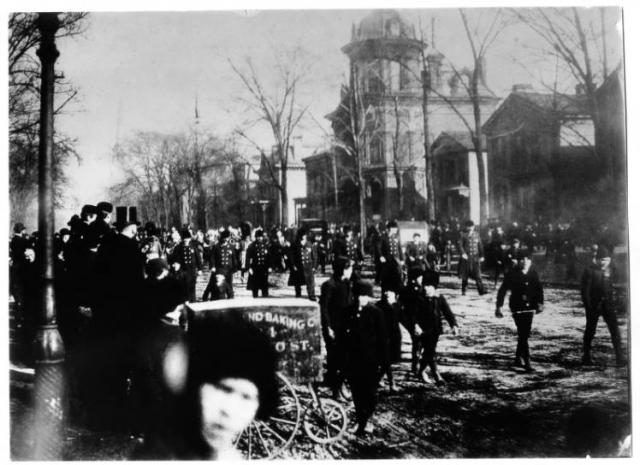
| 1889 Euclid Avenue during a Washington's Birthday Parade |
Again, Clamor and family fit into these skilled craftsmen, as he was a Cabinetmaker, he had a son was a tailor, and another was a tinsmith, a son-in-law that was a blacksmith and another who was also a tailor.
Eugene Brueggeman has a bed that was made by Clamor that was passed down to his son Louis, then to the grand-son Rudolph, and then to Eugene the great grandson. Hopefully, I can get a picture to share with you all one day.
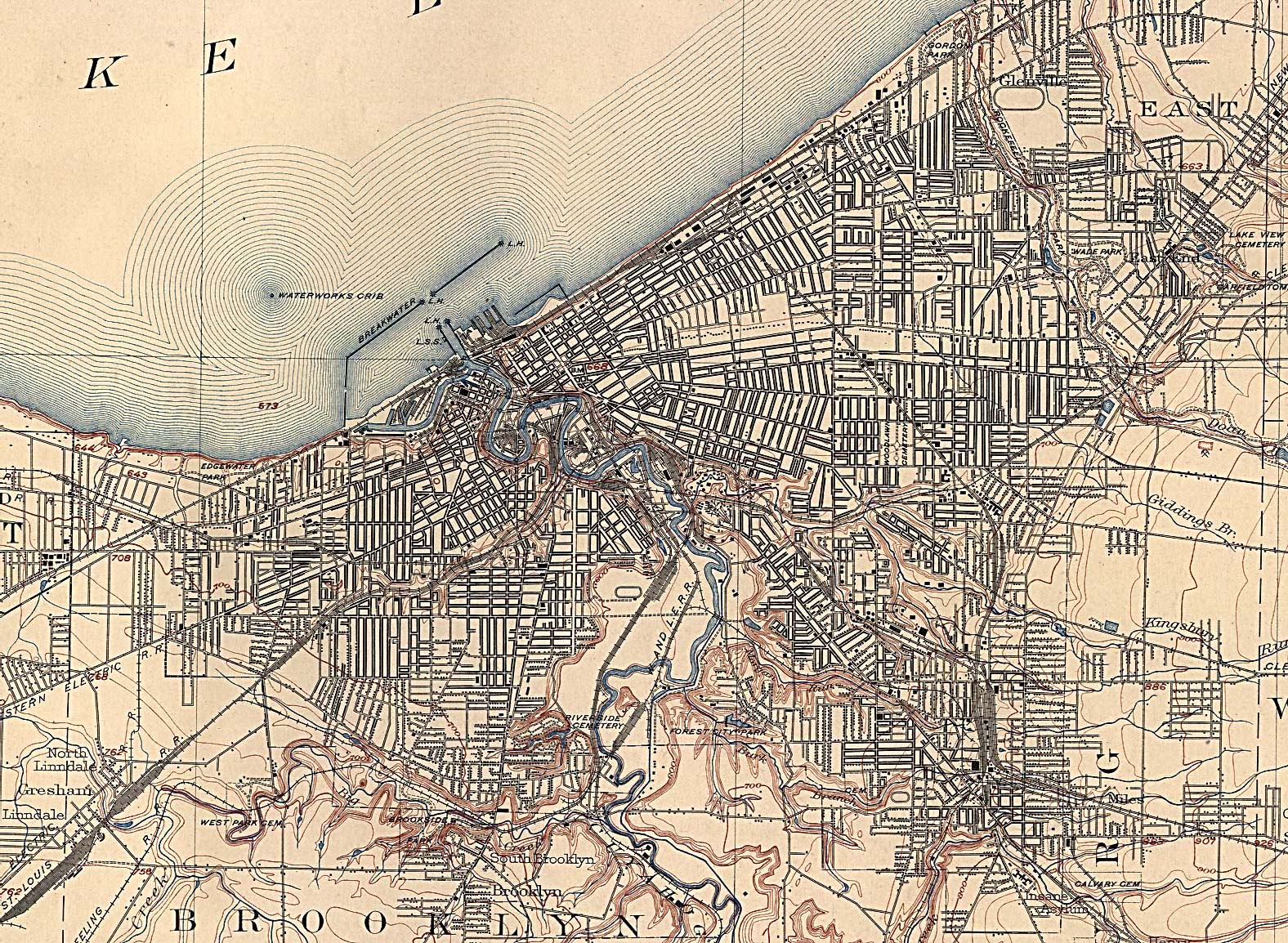
| 1904 Map of Cleveland |
Thursday, March 17, 2011
Clamor's Funeral and Burial
His funeral service at St. Luke's Church. They had been members for many years at Trinity Church and I don't know when he switched. He was buried at the Lutheran Cemetery next to his wife.
His daughter, Anna Louise Brueggeman Benhoff, was also buried on this day in 1917. She is also buried in the Lutheran Cemetery
Monday, March 14, 2011
On this day in 1909
Clamor VL Brueggeman died on this day in 1909. He was 92 years, 11 months and 14 days old and cause of death was Acute Bronchitis.
Thursday, March 3, 2011
On this day in 1816
Clamor Ludwig Vicktor Brueggemann was born on this day in1816. He was the son of Johann Friedrich Brueggeman and Catrine Dorothea Kumming. He was their fourth child and second son. He was born in Astrupp SchledehausenOsnabruck, Hannover, Niedersachsen, Germany.
Thursday, February 24, 2011
Marie Anna Hermscheips Brueggemann
Maria died on February 20, 1889. She was the second wife of Clamor V.L. Brueggemann. He lived for 20 more years. She was buried on this day.
We are somewhat uncertain about her age. A family tree that was done in 1922 had her birth year as 1828. The City of Cleveland Death Certificate listed the year as 1828 but the ship's record when she immigrated list it at 1819 but I think that was an error on the part of the clerk aboard the ship, maybe he meant 1829. The 1870 census lists the year as 1824. The death certificate lists her cause of death as Heart disease.
They are buried together in the Lutheran Cemetery in Cleveland.
Thanks to a volunteer of Findagrave.com for these pictures.
We are somewhat uncertain about her age. A family tree that was done in 1922 had her birth year as 1828. The City of Cleveland Death Certificate listed the year as 1828 but the ship's record when she immigrated list it at 1819 but I think that was an error on the part of the clerk aboard the ship, maybe he meant 1829. The 1870 census lists the year as 1824. The death certificate lists her cause of death as Heart disease.
They are buried together in the Lutheran Cemetery in Cleveland.
Thanks to a volunteer of Findagrave.com for these pictures.
Thursday, February 3, 2011
Clamor Ludwig Victor Brueggemann
As I mentioned last week, CLVB was listed as a joiner.
I haven't located him on the 1860 Census yet, probably spelling or transcription errors..
In the 1870 Census, his name is listed as Lewis and is a cabinetmaker.
In the 1880 Census, his name is listed as Louis and is a carpenter.
In the 1888 Cleveland City Directory, his name is listed as Ludwig and is listed as retired.
There is no 1890 Census due to a fire that destroyed the records
In the 1900 Census, his name is listed as Ludwig and listed as retired.
I haven't located him on the 1860 Census yet, probably spelling or transcription errors..
In the 1870 Census, his name is listed as Lewis and is a cabinetmaker.
In the 1880 Census, his name is listed as Louis and is a carpenter.
In the 1888 Cleveland City Directory, his name is listed as Ludwig and is listed as retired.
There is no 1890 Census due to a fire that destroyed the records
In the 1900 Census, his name is listed as Ludwig and listed as retired.
Wednesday, January 26, 2011
Clamor Ludwig Victor Brueggemann Occupation
On the ship's manifest when CLVB arrived in New York, his occupation was listed as a Joiner. A joiner is a more specialized carpenter.
According to Wikipedia:
A joiner differs from a carpenter in that he or she cuts and fits joints in wood that do not use nails, usually in a workshop environment since the formation of the various joints generally requires non-portable machinery. A carpenter would normally work on site. Cabinet makers who specialise in manufacturing furniture are regarded as producing fine joinery.
The "joinery" and "joiner" usage is obsolete in the USA, although the main carpenters' trade union still calls itself the United Brotherhood of Carpenters and Joiners of America.
A "joiner" would generally produce items such as interior and exterior doors, windows, stairs, tables, bookshelves, etc.
I recently discovered that there is a piece of CLVB's work in exsistence. Rev. Eugene Brueggeman (son of Rudolph, grandson of Louis) has a bed that was made by him. He promises to share pictures which I'll share with you.
Friday, December 17, 2010
Zion Lutheran Church, Cleveland and the First Christmas Tree
Clamor Brueggeman and his family were members of Trinity Lutheran Church in Cleveland. He arrived in 1860 from Hanover. Trinity's first pastor, the Rev. John Lindemann of Hanover, Germany, came to Cleveland with his family in August of 1853, and resided with (and worked as an assistant to) Pastor HC Schwan of Zion Congregation. He was assigned to serve the newly established Trinity conrgregation in Ohio city
Zion has the distinction of being the first Christmas Tree in a Church. The pastor, Heinrich Christian Schwan, was from Hanover, the same area in Germany that Clamor was from.
It is likely that Clamor and his family were very familiar with the tradition of a Christmas tree and his Pastor, Rev. Lindemann likely carried on the tradition started by Rev. Schwan which beginnings are told below.
Zion has the distinction of being the first Christmas Tree in a Church. The pastor, Heinrich Christian Schwan, was from Hanover, the same area in Germany that Clamor was from.
It is likely that Clamor and his family were very familiar with the tradition of a Christmas tree and his Pastor, Rev. Lindemann likely carried on the tradition started by Rev. Schwan which beginnings are told below.
The History of Zion's Christmas Tree (this is copied from their website)
On Christmas Eve morning 1851, young Heinrich Christian Schwan, newly installed pastor of Zion Lutheran Church in Cleveland, strode out into the forest near his parsonage and chopped down a small, beautifully shaped evergreen.
The couple spent the afternoon festooning the tree with cookies, colored ribbons, fancy nuts and candles. The crowning touch would be the cherished silver star that Schwan had brought with him from his boyhood home in Hannover, Germany. The star was a powerful reminder to him of how happy his Christmases had been as a child.
He wanted to share this same happiness with his congregation, most of whom were also German-born and thus likely to have seen a Christmas tree in their pasts. The custom hadn't caught on yet in America. In fact, to Schwan's knowledge, this was the first time that such a tree had appeared within a church this side of the Atlantic.
Once the tree was fully trimmed, Schwan carefully placed it in a prominent spot in the chancel. All that remained now was to light the candles bedecking its boughs. Standing back, gazing admiringly at their work, Heinrich and Emma could hardly help thinking, "Won't the congregation be surprised tonight!"
The people were surprised all right. Most were delighted. For them, seeing their handsome young pastor reading the Christmas story beside his bright, blazing tree enkindled wonderful Christmastime memories from the Old Country.
For others, however--those not familiar with the idea of a Tannenbaum, especially one in church--it was not such a blessing.
"Oh, my goodness!" one lady gasped, covering her eyes. "What in the world is this supposed to mean?"
"A tree in the chancel?" roared an indignant man. "What kind of a minister are you?"
Within a day or two, Herr Schwan's Christmas tree was the talk of the town, and the talk was not good. A prominent local newspaper called it "a nonsensical, asinine, moronic absurdity." It editorialized against "these Lutherans . . . worshipping a tree . . . groveling before a shrub" Worse, it recommended that the good Christian citizens of Cleveland ostracize, shun and refuse to do business with anyone "who tolerates such heathenish, idolatrous practices in his church."
This, obviously, was bad press for the struggling immigrant members of Zion, especially those with stores and other businesses dependent on the public's goodwill. And all fingers of blame pointed to the same man: the stunned, well-meaning Schwan.
To his credit, however, the young pastor, though sorely chastened, did not cave in at least not right away. His Christmas tree was still in the chancel the following Sunday. But then it came down. Soon thereafter, Emma discovered Heinrich's beloved tree-topping silver star in the trash.
She cleaned it up and presented it to him. "Why did you throw this away?" she asked."Because," he said disconsolately, "there never will be another Christmas tree in Cleveland." "Nonsense!'' she replied. ``This year you put up the first tree, and next Christmas there will be many trees in Cleveland.'' Emma saved the star, and her prediction came true beyond her wildest dreams.
During the following year, Schwan, perhaps inspired by his stalwart wife, carefully researched the issue of Christmas trees. He ultimately concluded that such trees were not a sacrilege but rather a solid Christian custom - a custom in which Christians could express their joy at the birth of the Christchild.
He wrote many letters and received replies assuring him that lighted and decorated Christmas trees were de rigueur in many Christian countries. Emboldened by this knowledge--the fact that Christmas trees were not of pagan origin--he actively promoted their use as symbols of the joy of Christmas.
On Christmas Eve 1852, Schwan's church again displayed a blazing Christmas tree. But this time it was not the only one in Cleveland. In fact, decorated trees appeared in homes all over town, and within five years Christmas trees were going up in homes and churches all across the country!
Although Pastor Schwan, as we now know, was not the first person to decorate a Christmas tree in North America, he was the first to introduce one into a church. And he was almost singlehandedly responsible for this custom gaining widespread acceptance and popularity in the United States.
Contributing to this story are authors of other works relating to H.C. Schwan and his tree: Del Gasche, "A Christmas Tree? In Church?," Farmland News, 1989; Penne L. Restad, Christmas in America, Oxford University Press, 1995; and Helen Jensen, "Cleveland's First Christmas Tree" (self-published, 1996).
Subscribe to:
Posts (Atom)