Showing posts with label louis brueggemann. Show all posts

Wednesday, August 31, 2011

1910 Census: Louis Brueggeman

Louis was living with his wife and family in Cleveland.  His father, Clamor, had died in 1909.  I have been told that this was Clamor's house.  He lived with Louis prior to his death.  


Louis was 48 and his wife, Wilhelmina (known as Minnie) was 44.
Children:   Meta (19), Rudolph (17), Edward (15), Cornelia (8) and William (5)


Louis was listed as being a Grocer with his own store.  Their daughter, Meta, was a Stenographer for a Carbon Company and their son, Rudolf, was listed as an Surveyor's Apprentice, a skill that was to be greatly valued when he served in World War I.   Meta and the three youngest children attended school after Sept 1, 1909.


This is a photo taken in 1910 in a Cleveland grocery store.
It is not Louis' store, but it gives a glimpse what his store may have looked like at the time. 


They were living at 2034 West 93rd Street. Here is current info on the house.  The house was listed on the Census as being owned mortgage free. It was built in 1896 and today has five bedrooms.  According to Google Maps, this is the house today.  Kind of cute.
The neighborhood was not a German enclave.  Most of the residents were born of Native born citizens and those that weren't, most were English.  There occupations ranged from an Elevator Man at a hotel, to a mailman, to foremen, to a publisher.  Most owned their homes, many without a mortgage.

Sunday, May 1, 2011

Cleveland Ohio and the German Community

The Encyclopedia of Cleveland has great information regarding the history and contributions of German Americans in Cleveland.  Here are a few excerpts: 

GERMANS formed one of Cleveland's largest and most influential nationality groups in the 19th and 20th centuries. Although not as large as the German communities in some northern cities, the local community had an important influence on the city's economic, educational, and cultural life. Cleveland and other lake cities lagged a few years behind Cincinnati and St. Louis in the influx of Germans, for both of these cities gained German immigrants via the riverways and the National Road. Prior to the opening of the OHIO AND ERIE CANAL, Cleveland's Germans were chiefly those of German descent from Pennsylvania, New York, and Maryland whose forebears had generally come to America before the Revolutionary War; many of Cleveland's early civic leaders, such as LEONARD CASE†, claimed German heritage of this kind. Germans began arriving in Cleveland in substantial numbers during the 1830s, first settling along Lorain St. in Brooklyn, and along Superior and Garden (Central Ave.) streets on the east side. As the city expanded during the 19th century, succeeding generations moved east, west, and south, eventually fusing with other elements of the total population.


We know from other records that Clamor and family members lived in the Lorain St area.
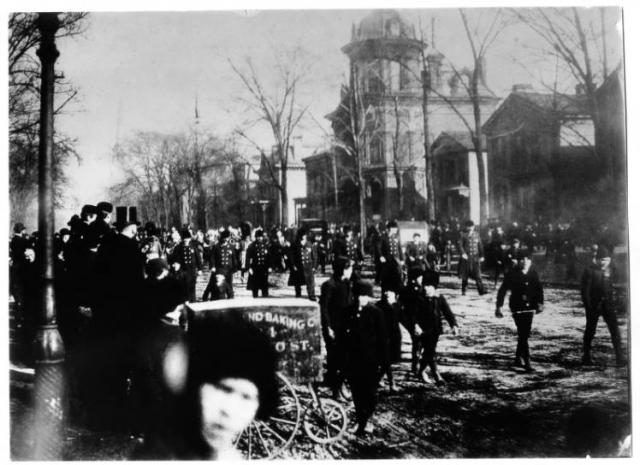
1889 Euclid Avenue during a Washington's
Birthday Parade
Among skilled craftsmen ca. 1850, Germans outnumbered all others, even though they composed a lesser proportion of the total population. They worked as jewelers, tailors, makers of musical instruments (e.g., pianos, such as those built by the DREHER PIANO CO.), cabinetmakers, and "machinists" (i.e., mechanics). The Germans' introduction of beer as a popular beverage perhaps aided in tempering the drinking habits of Cleveland natives by diminishing the consumption of hard liquors. Initially, the German BREWING AND DISTILLING INDUSTRY in Cleveland consisted of small breweries, each intended to serve only the brewer's own tavern. The breweries later expanded to become wholesale suppliers--notably LEISY BREWING CO.GUND BREWING CO., Schlather, and PILSENER BREWING CO. After the Civil War, Cleveland Germans, like other American Germans, distinguished themselves in the manufacturing of pianos, furniture, coffins, clothing, stoves, metal products, and carriages, and later in the tool-and-die industry and building trades. THEODOR KUNDTZ† was a particularly important cabinet manufacturer. Germans were also prominent in the wholesale and large-scale food businesses, such as the Haserot Co. and the WEIDEMAN CO., the retail grocery business, wholesale baking enterprises such as the LAUB BAKING CO., retail baked goods, and the restaurant business.


Again, Clamor and family fit into these skilled craftsmen, as he was a Cabinetmaker, he had a son was a tailor, and another was a tinsmith, a son-in-law that was a blacksmith and another who was also a tailor.  
Eugene Brueggeman has a bed that was made by Clamor that was passed down to his son Louis, then to the grand-son Rudolph, and then to Eugene the great grandson.  Hopefully, I can get a picture to share with you all one day.
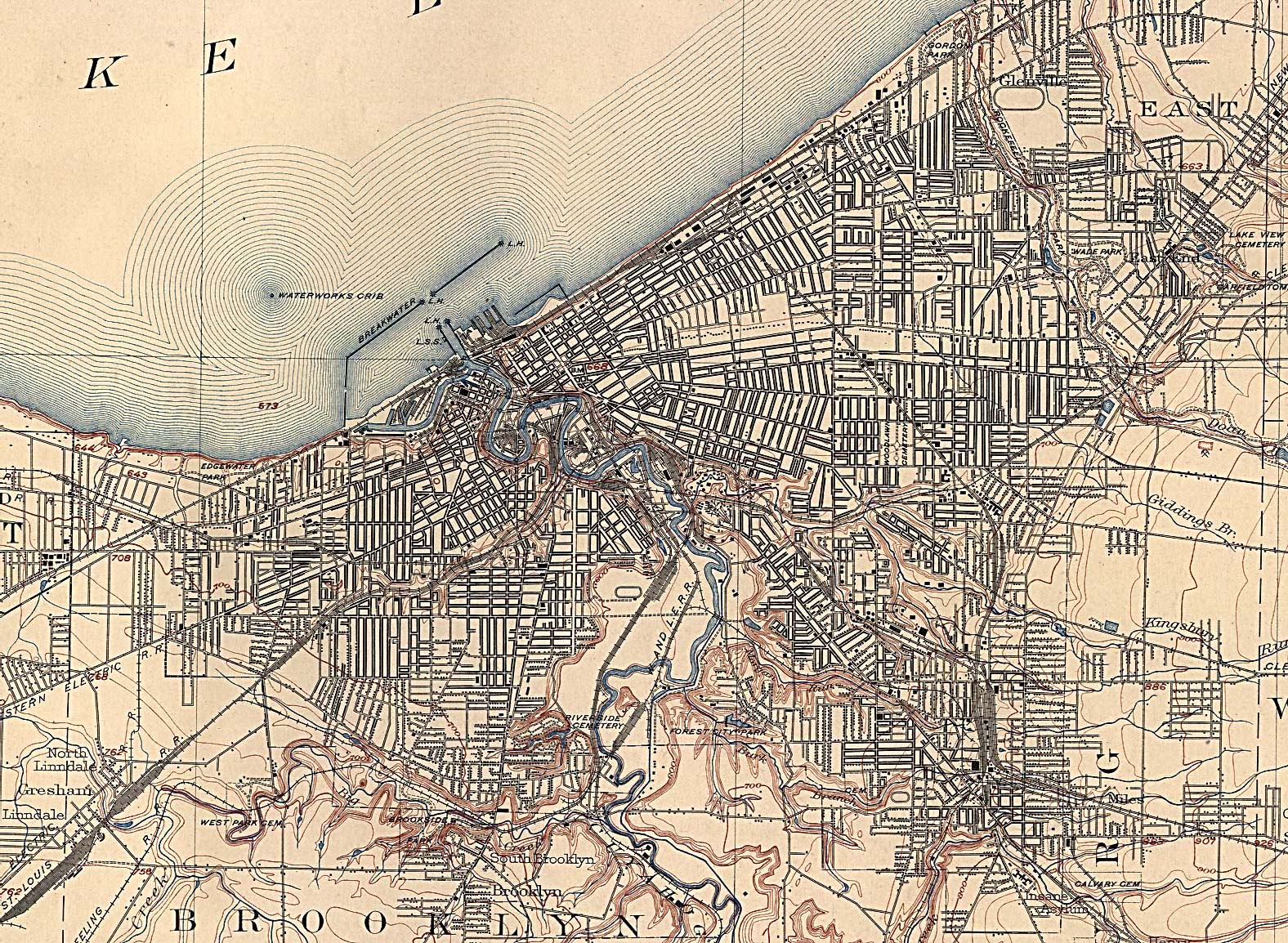
1904 Map of Cleveland

Sunday, January 9, 2011

Burial of Louis Henry Brueggeman

Louis was buried on this day.  He is buried at the Lutheran Cemetery in Cleveland, Section G, Lot 14.
Thanks to a volunteer from FindaGrave.com for this picture of his headstone.
 This stone is at the base of a larger stone with his father and mother on the reverse of the stone.  I am guessing that the larger stone is not original as it is not in the style of the day and Briueggeman is spelled with one "N".

He was also known as Ludwig Heinrich Brueggemann.  His funeral service was held at St. Luke's Lutheran Church, a German congregation.  I am not sure when they left Trinity for St. Luke's.


Thursday, January 6, 2011

On this day in 1922

Louis Henry (or Ludwig Heinrich) Brueggeman died.  He was the son on Clamor Victor Ludwig Brueggeman.  He was much younger than his father when he died.  He was only 60.  Louis was a tailor by trade.
Brueggemann, Louis H.
Date: January 6, 1922

Source: Source unknown;  Cleveland Necrology File, Reel #011.
Notes: Brueggemann-Louis H., beloved husband of Wilhelmina, January 6, 1922. Funeral Monday, January 9, at 2 p. m., from late residence and 2:30 p. m. from St. Luke's church, corner W. 85th street and Sauer avenue.