Showing posts with label cleveland. Show all posts

Saturday, January 21, 2012

Trinity Lutheran Cleveland Ohio

These are pictures of Trinity Lutheran from the early 1930s.  This was the church that C.L.V. Brueggemann and his family attended.  I spent a long time tonight trying to find an early map to place the church in relation to where they lived.  The church is at the corner of 30th and Lorain.  


I realized after searching early maps that many streets were renamed in 1906.  Many people believe that the streets were renamed in response to anti-German sentiment around the time of the first World War but it was unrelated.  I wasn't able to find the original street name but I will look at Census records to see if I can match it up.


The West Side was originally called Ohio City and was annexed to Cleveland in the 1850s.
From Trinity's Website:   Trinity was founded in 1853, on it's present site, in a small wood structure that was subsequently moved to, and still exists at, West 32 and Chatham.  The congregation exploded in size and the current bldg. was erected in 1873 to serve 1,500 West Side parishioners.  The building has been called "One of the finest examples of a Victorian Gothic Meeting House in this part of the Country".  During the fifties, when most congregations were relocating to the suburbs, the congregation made the commitment to stay in the neighborhood.  The size of the congregation steadily declined until the early 1990's.   In 1994, the average worship attendance was in the low 80's.  Due to innovative programming and a new contemporary service, in additional to the traditional service, the attendance has increased 100% to an average worship attendance in the 150's, and continuing to grow.
Trinity also has a special organ according to this from The Plain Dealer:

An anonymous donor who loves Baroque organ music has pumped $100,000 into a fund supporting the restoration of the Beckerath organ at Trinity Lutheran Church on Cleveland's West Side.
Until recently, the Beckerath Organ Restoration Fund stood at $142,000, about half the amount needed to refurbish the 1956 instrument. The $100,000 donation will enable the project to be completed this year, said organist Florence Mustric, who chairs Friends of the Beckerath.
Mustric said 92 percent of the $142,000 came "not in major gifts, but in small and modest donations over three years, ranging from a great many $1 bills to a few $1,000 checks." The donors have comprised music lovers from across Northeast Ohio and the country, including members of the Organ Historical Society.
The church's admired organ was built by Rudolph von Beckerath of Hamburg, Germany. It is being restored by Leonard Berghaus, founder of Berghaus Pipe Organ Builders in Bellwood, Ill., who was inspired to become an organ builder by Trinity's Beckerath.
The instrument has been undergoing restoration in stages, as funding has allowed, since 2007. After a concert Sunday, Jan. 16 by organist David Tidyman, who'll present a program titled "Bach as Visionary and Mystic," pipes and several divisions of the Beckerath will go to Berghaus for restoration.
Mustric said this stage should be completed by April, after which the final stage, including renewal of the console, will follow.
The anonymous donor has been a fan of the Beckerath for two decades, said Mustric.
"When we first met, I expressed surprise that he knew nothing about it," she said. "I said, 'I have the keys to the candy store' and invited him to come hear it and play it. His first words on hearing it were, 'This is not the candy store.' Stunned, I said, 'No?' He said, 'This is no candy store - this is Fort Knox!' "
Mustric said the $100,000 donation will make it possible for her and Trinity organist and director of music Robert Myers to pursue foundation support for the restoration.
"Bob is speechless," said Mustric of the $100,000 donation. "I'm stunned, but, as you see, I am not speechless, which is a good thing."
Mustric and Myers alternate as soloists in free recitals on Wednesday afternoons in Trinity's Music Near the Market series. The church is at 2031 West 30th St., Cleveland

Monday, July 25, 2011

The West Side Sewing Circle of The Lutheran Hospital

I am not sure how David Reinhardt got this booklet but it is full of recipes submitted by some familiar names:  Brueggemann, Bennhoff, Fortlage
I figure it was used for a fund raiser for their activities at the hospital.   I found the following article about the Hospital and the Sewing Circle from the Cleveland Press:

Eighty-six Cleveland German women, comprising the West Side Frauenverein, with $233 in their treasury, started the Altenheim, German old folks' home at 7719 Detroit Ave. in 1887.

They held their first meeting for this purpose on Aug. 9 1886, in the Socialer Turnverein. Leaders of the idea included Mrs. Louise Zuelling, Mrs. Jacob Mueller, Mrs. Louise Schlather, Mrs. Karl Schmidt, Mrs. E. Ackerman and Mrs. Charles Ranch.

Bazaar followed bazaar and countless activities were pursued by these women to raise money. They succeeded in interesting a group of German businessmen to give larger donations and on treasury showed $8,051.

These original benefactors included Louis Schlather, J. C. Weideman, Hans Tiedeman, C. G. Gehring, Isaac Leisy, G. V. Muth, Charles Ranch, John Meckes, Mrs. C. Stolz, Mrs. J. Baehr.

With $8,000 in the bank the brave women bought a large plot at the present address for $11,000 and proceeded to raise more funds.

The Walworth Run Bridge Club, the East Side Frauenverein, Mrs. Shlegel, the German Day Committee and the Plattdeuscher Volkfest Committee were among new donors.

With $12,125 in the bank and with Hans Tiedeman as chairman of the building committee, the erection of the home was started and the cornerstone was placed on Sept. 4, 1891. Jacob Krausz helped collect more money among German businessmen and when the Altenhelm.was formally dedicated on Sept. 18, 1892, the cost, $22,142, was all paid.

Hospital Legacy
The idea of founding the Lutheran Hospital grew from a legacy of $4,000 left in 1895 by Mrs. Katherina L. Schierbaum, a Cleveland German woman, to the Lutheran Church for needed but undesignated services for the poor and the sick.

Consequently nine Cleveland Lutheran churches, nearly all German, formed the Evangelical Lutheran Hospital Assn. and on May 26, 1896, the Lutheran Hospital received its state charter.

First officers of the hospital at the time of its founding were the Rev. J. J. Walker, president; F. M. Leuther (father of Winfred, the former president of Western Reserve University), secretary; William Wishmeyer, treasurer; H. F. Luekens and Louis Morton, trustees.

In September, 1896, a frame house was brought at the apex of W. 2Sth and West 29th. St. on Franklin Circle and the building was equipped, rather simply, for hospital purposes.

Opened in 1896
Mrs. Clara Mueller served as matron, cook and nurse. The modest hospital opened in October, 1896, with George Zehnder as the first patient. By the end of the year the hospital had cared for 23 patients.

Of the many groups that have been faithful supporters of Lutheran Hospital from its very inception is the West Side Sewing Circle, organized on May 4, 1897. Included among the organizers were Mrs. Louise Henke, Mrs. John Grieve, Mrs. Henry Moyer, Mrs. August F. Leopold, Mrs. Lena Lange, and Mrs. A. C. Lampe.

In 1898 the Mark Hanna home at 2603 Franklin Blvd. was acquired and occupied by Lutheran Hospital and in the same year the nurses' school was established.

Acquire More Land
In 1912 the Wormington property, immediately east of the old Hanna home, was purchased for a nurses' home. The hospital grew so rapidly that the Hanna and the Wormington homes were razed to make way for a new hospital building, dedicated July 9, 1922.

Eventually additional property was acquired around the building, a new wing was erected, parking lots were made, and a new nurses' home was built. The latest addition and modernization was done last year.

Present superintendent of Lutheran Hospital is Lee S. Lanpher.

Sunday, May 1, 2011

Cleveland Ohio and the German Community

The Encyclopedia of Cleveland has great information regarding the history and contributions of German Americans in Cleveland.  Here are a few excerpts: 

GERMANS formed one of Cleveland's largest and most influential nationality groups in the 19th and 20th centuries. Although not as large as the German communities in some northern cities, the local community had an important influence on the city's economic, educational, and cultural life. Cleveland and other lake cities lagged a few years behind Cincinnati and St. Louis in the influx of Germans, for both of these cities gained German immigrants via the riverways and the National Road. Prior to the opening of the OHIO AND ERIE CANAL, Cleveland's Germans were chiefly those of German descent from Pennsylvania, New York, and Maryland whose forebears had generally come to America before the Revolutionary War; many of Cleveland's early civic leaders, such as LEONARD CASE†, claimed German heritage of this kind. Germans began arriving in Cleveland in substantial numbers during the 1830s, first settling along Lorain St. in Brooklyn, and along Superior and Garden (Central Ave.) streets on the east side. As the city expanded during the 19th century, succeeding generations moved east, west, and south, eventually fusing with other elements of the total population.


We know from other records that Clamor and family members lived in the Lorain St area.
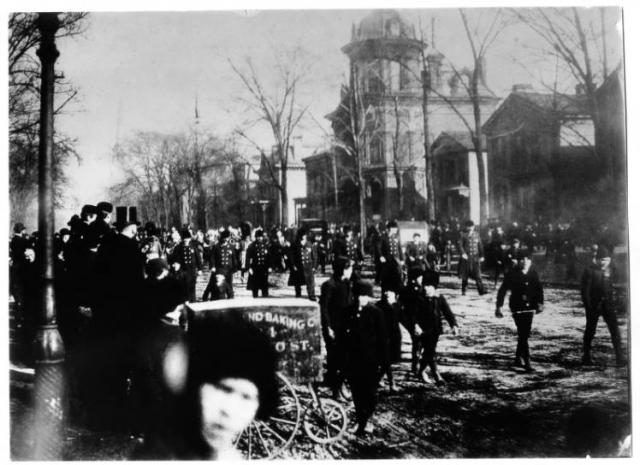
1889 Euclid Avenue during a Washington's
Birthday Parade
Among skilled craftsmen ca. 1850, Germans outnumbered all others, even though they composed a lesser proportion of the total population. They worked as jewelers, tailors, makers of musical instruments (e.g., pianos, such as those built by the DREHER PIANO CO.), cabinetmakers, and "machinists" (i.e., mechanics). The Germans' introduction of beer as a popular beverage perhaps aided in tempering the drinking habits of Cleveland natives by diminishing the consumption of hard liquors. Initially, the German BREWING AND DISTILLING INDUSTRY in Cleveland consisted of small breweries, each intended to serve only the brewer's own tavern. The breweries later expanded to become wholesale suppliers--notably LEISY BREWING CO.GUND BREWING CO., Schlather, and PILSENER BREWING CO. After the Civil War, Cleveland Germans, like other American Germans, distinguished themselves in the manufacturing of pianos, furniture, coffins, clothing, stoves, metal products, and carriages, and later in the tool-and-die industry and building trades. THEODOR KUNDTZ† was a particularly important cabinet manufacturer. Germans were also prominent in the wholesale and large-scale food businesses, such as the Haserot Co. and the WEIDEMAN CO., the retail grocery business, wholesale baking enterprises such as the LAUB BAKING CO., retail baked goods, and the restaurant business.


Again, Clamor and family fit into these skilled craftsmen, as he was a Cabinetmaker, he had a son was a tailor, and another was a tinsmith, a son-in-law that was a blacksmith and another who was also a tailor.  
Eugene Brueggeman has a bed that was made by Clamor that was passed down to his son Louis, then to the grand-son Rudolph, and then to Eugene the great grandson.  Hopefully, I can get a picture to share with you all one day.
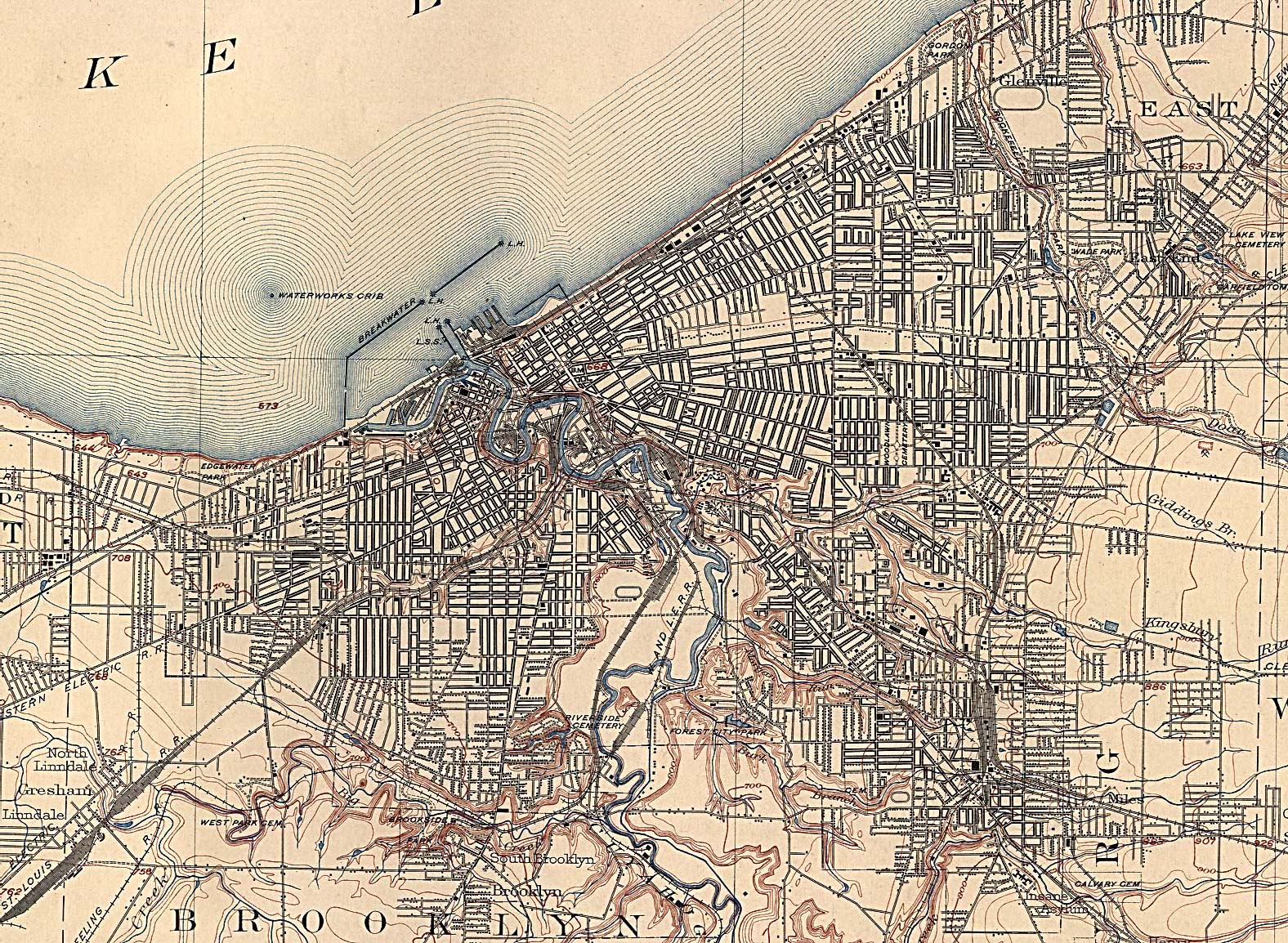
1904 Map of Cleveland