Showing posts with label ezra riley 1. Show all posts

Friday, November 25, 2011

Another Google Find for Ezra Riley

I am pretty sure this is "our Ezra" (article on the left).  I could find no other Ezra Rileys in the 1881 or 1891 census in Birmingham.  Ezra lived in the Aston section of Birmingham during this time.  He contracted with this Architect named Hopkins to erect 36 houses and cottages in the Chain Walk, Lozells.
This from the Birmingham Gazetteer that lists all the Street names.   Chain Walk is a lane in Lozells which runs from Lozell Road to Birchfield Road.  This is very close to where Ezra lived in Aston.
Here are some more pictures of the area:
"Houses ready for demolition in Chain Walk, a road with a 
pronounced gradient, joining Lozells Road and Birchfield Road."


Tuesday, November 22, 2011

It pays to Re-Google

While waiting in a doctor's office today, I re-googled Ezra Riley on my IPad.  I haven't googled him in a long time and I found something new.   Ezra received a Patent in 1873 while he was the manager of Pontnewynydd Iron Works in Wales.


From Wikipedia: The puddling furnace is a metalmaking technology used to create wrought iron or steel from the pig iron produced in a blast furnace. The furnace is constructed to pull the hot air over the iron without it coming into direct contact with the fuel, a system generally known as a reverberatory furnace or open hearth furnace. The major advantage of this system is keeping the impurities of the fuel separated from the charge.

Friday, May 20, 2011

Wedding Anniversary of Ezra Riley and Jane Roberts

I am in SC and have totally lost track of what day of the week it is.  I posted Family Picture Friday on Thursday night.  Oh Well.


Today is the wedding anniversary of Ezra Riley and Jane Roberts.  They were married in Manchester in 1853. 
St. Mary's Church, Address 22 New St, Parish of Manchester in the County of Lancaster, by J.H. Hatfield, Her address was 22 New Street, father Thomas Roberts, witnessed by Adam Plant and Mary Ann Baker

Ezra's witness was Adam Plant.  Adam was listed on the 1850 Census as being a lodger at Ezra's home (actually his Aunt Grace's home).  His occupation was also a Blacksmith.

Ezra reported that his father was John Riley with the occupation of Spinner.  As I have mentioned before, I don't think Ezra's father will be known.  I think he "made up" this one.  On his marriage record to the second wife, Mary, he reported is father's name as Ezra  and that he was a Blacksmith.

Thursday, May 5, 2011

Cities of Birmingham (England) and Birmingham (Alabama)

I feel silly that I never made a connection between Birmingham England and Birmingham Alabama.  As you know, Birmingham has been in the news lately because of all damage locally because the tornadoes.  Birmingham England was one of the centers in England of the Industrial Revolution.  Ezra Riley moved there to work in the Iron industry there.  Birmingham Alabama was also a center of the iron and steel industry in the United States.  The Alabama city was named after the English city for obvious reasons.  The following information is from the following web site: http://historyengine.richmond.edu/episodes/view/4671

According to an 1889 article found in the Chautauquan, a popular weekly news magazine, Birmingham, Alabama was the future of the iron and steel industry in America. Seated in Jefferson County, which is located in central Alabama, Birmingham was named after the industrious steel city of Birmingham, England. Also known as the “Magic City” and “Pittsburgh of the South”, Birmingham had earned these titles after its immense industrial growth. Birmingham’s steel productivity was made possible by its twenty-five local blast furnaces. These twenty-five blast furnaces were used in the smelting process. Smelting is the process in steel making that removes the iron metal away from its ore.  Birmingham’s extreme industrial success was due to the locality of iron, which was found on nearby Red Mountain.  Red Mountain’s ridge runs southeast along the Magic City’s southern border and was named “red” after the color of the iron that was found there.
    Bertha Bendall Norton, a Birmingham historian writes, “If in early 1900 you had stood on Red Mountain where Vulcan, the largest iron statue in the world stands today, and gazed out upon this once sacred valley of Indians, you would, perhaps, have had a strange feeling of wonder, excitement and pride.”  The Pittsburgh of the South was exactly that, exciting and wonderful. New jobs were being created by the arrival of the steel and iron industries such as Sloss furnaces and Tennessee Iron and Coal Company, which opened in 1886.  Birmingham’s industry became self- sustaining and that began to concern northern industrialist who, at first, were not involved. Much of the United States was still oblivious to the Magic City’s capabilities of becoming the leading iron producer in the  industry. Birmingham was a city that worked around the clock in hopes for maximum production of steel.  Birmingham, Alabama of yesterday had proven itself worthy in the late nineteenth century and had indeed become the future of the iron and steel industry in America
Eureka Furnace, Birmingham, AL

Wednesday, April 6, 2011

Ezra Riley 1871 Wales

I was searching the internet today for more information on Ezra Riley.  I knew he lived in Pontnewynydd Wales in 1871 and was listed on that census as the Manager of Pontnewynydd Iron Works and the employer of "437 men and boys".  As I discussed a couple of weeks ago, he had been living in North Woolwich and was working for Henley.  I wondered why he moved to Wales and today I think I found the answer:


http://www.pontypool.bravepages.com/ironcoal.html

 at Pontnewynydd John Lawrence and William Morgan of
Pontnewynydd
Llanfoist in 1837 set up more furnaces; in 1845 these were bought by William Williams of Beaufort who had formerly kept the Company's shop for Crawshay Bailey but now owner of the Golynos works at Abersychan and living at Snatchwood House. He manufactured bars and rails but failed when the Mon. and Glamorgan Bank collapsed in 1851 and W. T. Henley, a London speculator, bought them for conversion into wire mills. Henley is said to have rolled the Atlantic Cable there, but they were soon closed down and remained idle for many years. 

So it looks like he moved there to roll cable for W.T. Henley!  On the Census, he is listed as living at Snatchwood House that is mentioned above.  I don't know how long the family was in Wales but by 1891, they are in Birmingham.

Thursday, March 24, 2011

Ezra Riley and the Missing 1861 Census

Since the 1861 Census for North Woolrich is missing, other sources are needed to verify that is where he was living.

First, we have the birth record of his son, Ezra Riley for 1862
This shows his birthplace to be Woolwich Arsenal.   His father's occupation is listed as Journeyman Blacksmith.

Another piece of evidence to verify the family's residence is this letter obtained by Mary Jane Riley Lacke.

This letter shows that he was a Manager of Cable and Telegraph Works and lived in North Woolwich in  Dec 1865.  It is interesting to note that he paid dues through 1878.  He had moved away at some point as we know he was in Wales in 1871.  

There are always alternatives to get at some of the information we need to put together the story.  It just isn't as easy as going to a Census Record.

Tuesday, March 15, 2011

Ezra Riley and the Henley Cable Company

We know that Ezra Riley worked for WT Henley Telegraph Works in Woolwich.  He was living in Woolwich at the time of the 1861 Census (even though it is lost).  Family lore is that he worked on the first transatlantic cable.  This is the first part of my exploration into Ezra's history with the cable.  He must have had fond feelings for Henley as he gave his son, Percy, the middle name of Henley.  Unfortunately, Percy died at age 2.


W.T. Henley’s Telegraph Works Co’s Cable Factories,
Woolwich And Gravesend.
Reprinted from the "Electrical Review" of May 17th, 1912.

The company, whose works are described in the following article, was founded by one of the most striking characters associated with the early history of electrical engineering—W.T. Henley, who by turns was a light porter, dock labourer, instrument maker, and telegraph engineer. He commenced the manufacture of submarine cable at North Woolwich in 1853, and made the shore ends for the Atlantic cables which were laid in 1865 and 1866, besides many other cables far too numerous to mention, for all parts of the world. In the course of his life-time, Mr. Henley made some 14,000 miles of submarine cable, and laid most of it with his own cable ships. He also established works for making iron-wire rods and sheet-iron in Wales, and carried out the drawing and galvanising of iron wire at the Woolwich works.

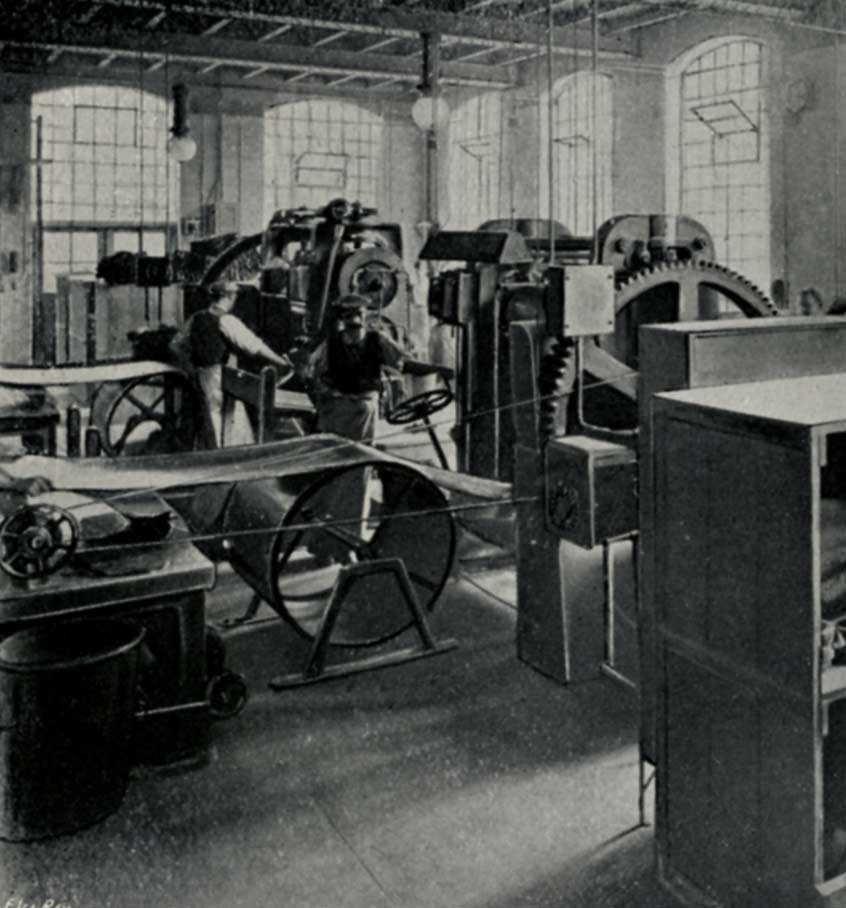
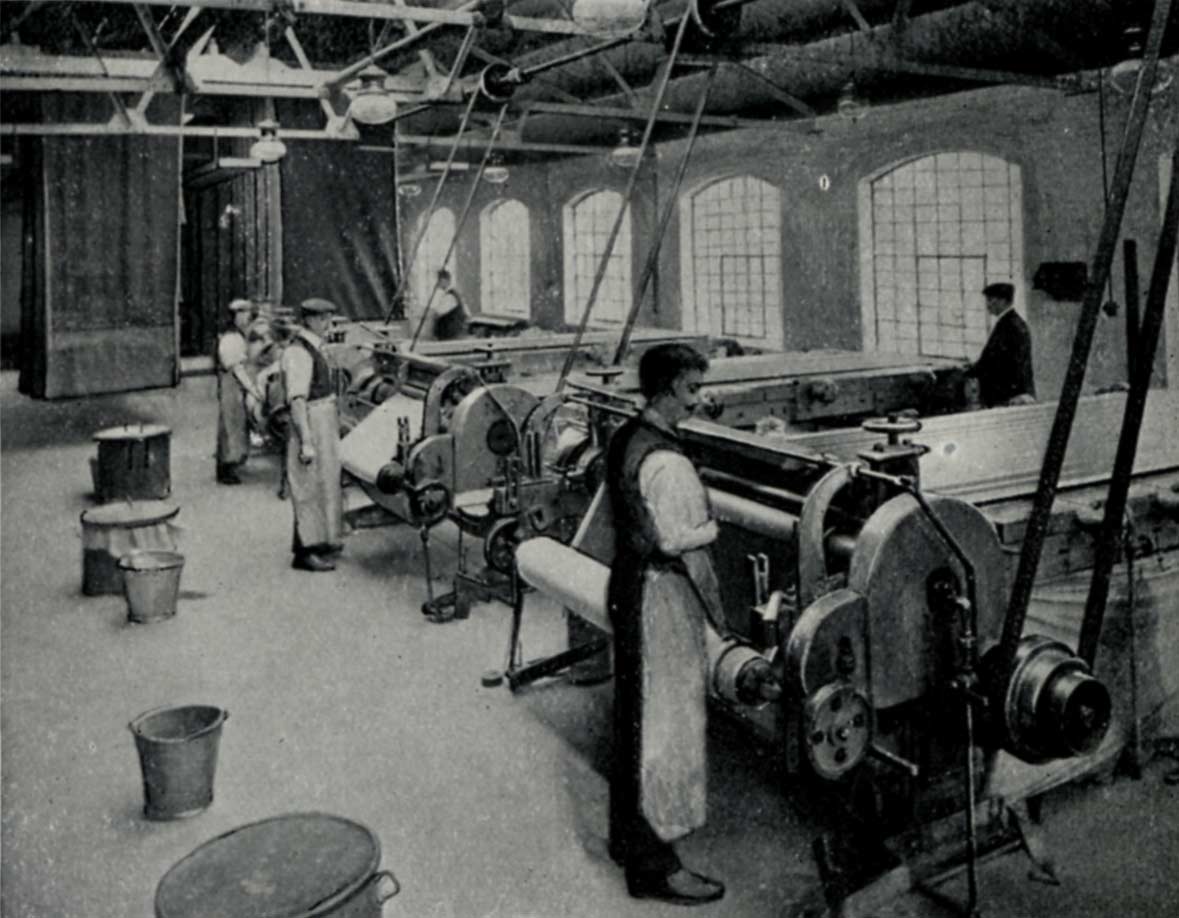
Rubber Mill, North Woolwich.

Rubber Spreading Shop.
The site of the factory at North Woolwich was chosen for convenience in dealing with submarine cable, which formed the principal product in the early days, and which had to be led direct from the works to the cable tanks on board ship; the factory was therefore established on the bank of the Thames at North Woolwich, the centre of the submarine cable industry of the world, and provided with a jetty for this purpose. On the opposite side it is bounded by the Great Eastern Railway, beyond which are the docks which convert this portion of the borough into an island. The remainder of the space thus cut off being fully occupied, there is no possibility of extension on the ground level, and, therefore, it has been necessary to erect buildings of several stories in order to provide adequate accommodation for the various departments. Moreover, as from time to time new manufactures have been introduced for which the works were not originally laid out, it has been difficult to carry out a satisfactory system of organisation.


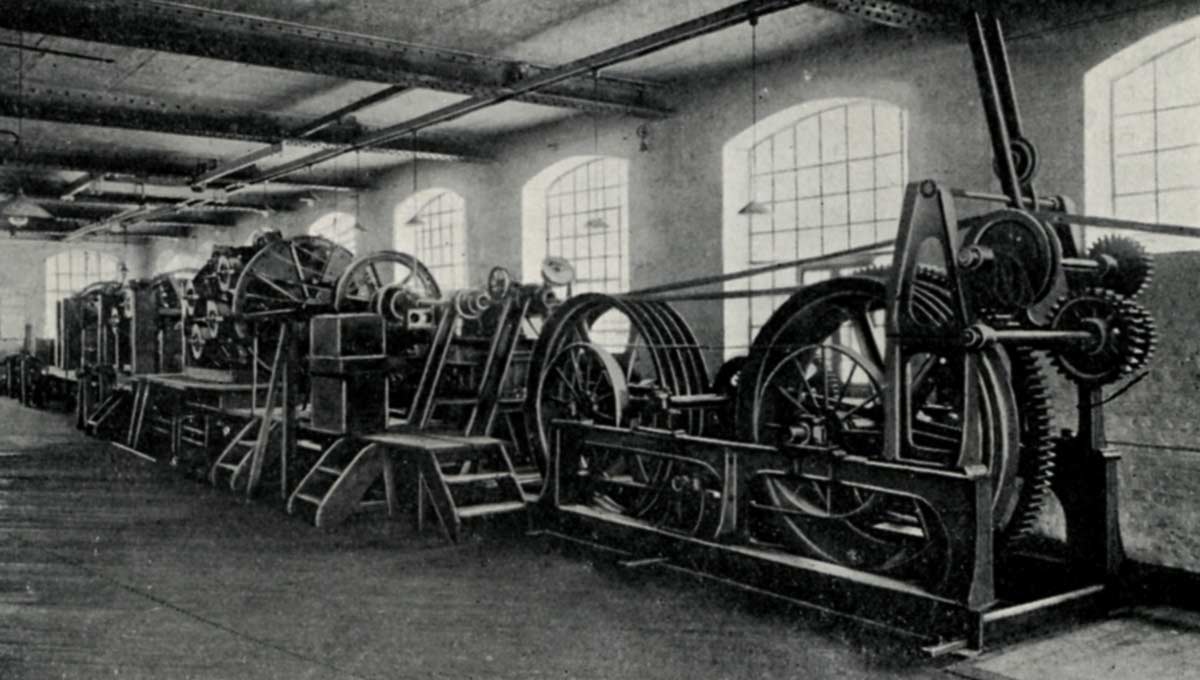
....—and the following notes and illustrations will give some idea of the plant and processes employed.

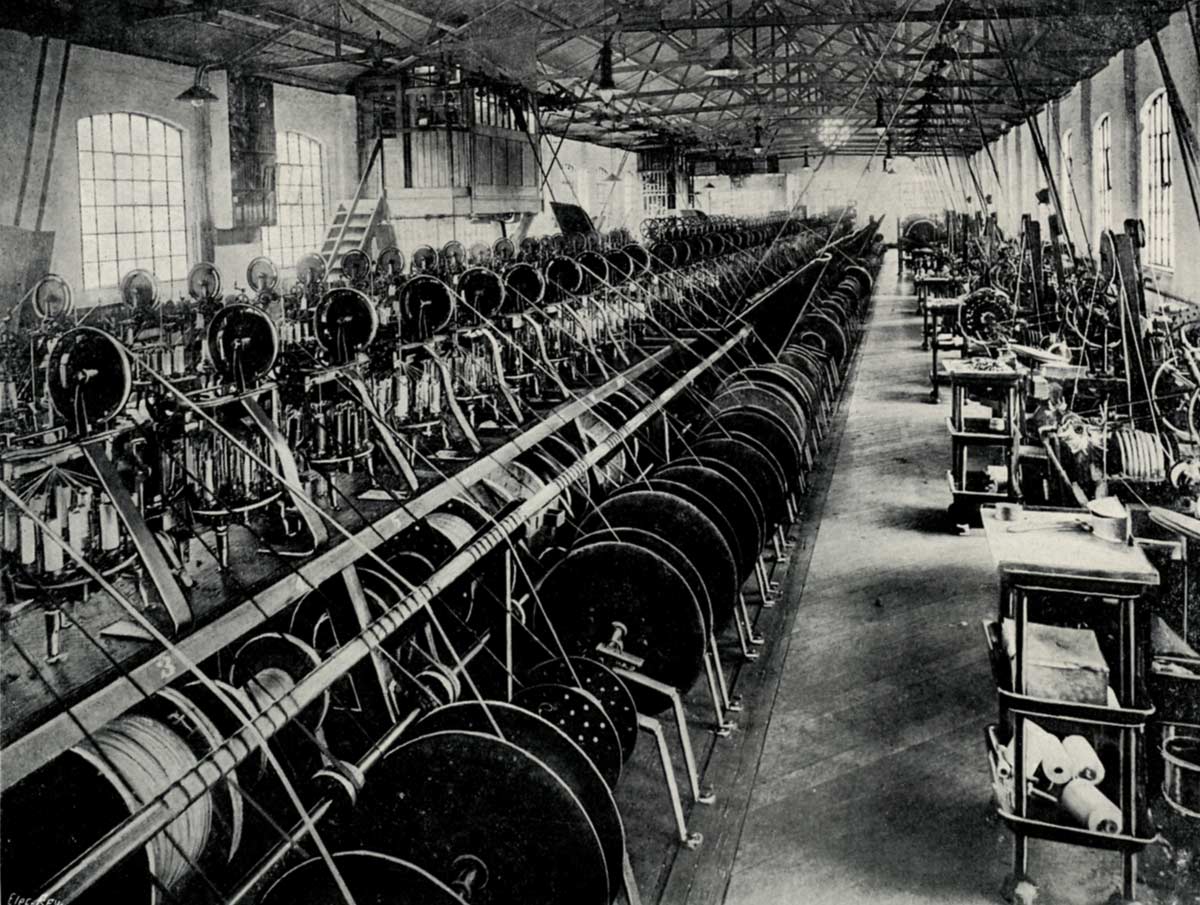
Braiding Shop, North Woolwich.
The whole of the machinery is electrically driven from generating plant in the works; owing to the very early adoption of this system, the pressure is only 110 volts—an example of the penalties of pioneering. Hitherto, although the company has shared the misfortunes of the Woolwich electricity supply undertaking, by way of the rates, it has not been able to derive any compensating benefit from the latter, the generating station being on the south side of the river. However, when the subway now under construction is completed, cables will be laid through it by the Borough Council, and it will then be possible to obtain a supply of electricity for night work, &c., from the mains.

Starting with the rubber works, the first department is the_ raw material stores, where an enormous quantity of copper wire of various sizes is kept in stock. The wire is tinned, if required, and is then stranded into cable in a stranding shop on the ground floor; in order to cope with the demand, the machines in this shop are kept running day and night throughout the year. A flexible cable of exceptional design was being laid up at the time of our visit, the number of wires in the conductor amounting to about 760.


Tuesday, January 4, 2011

Ezra Riley, a loyal family member

Ezra Riley (1828-1913)  will be discussed in detail on this blog as he is Thomas Roberts Riley's father.  There are few mysteries that have not yet been solved but we are working on.


I have discovered that he was a loyal family member through the records.  For example, his dead wife's (Jane Roberts) niece, Mary Roberts was living with his family in Wales in 1871.  He was remarried at the time.  Mary's father was Daniel Roberts, Jane's brother.  Mary was back with her parents in the 1881 census.  You wonder if her family was having financial difficulties at the time or one of the parents was ill or if they thought Wales would be good for her.


Also living with him in Wales was his cousin, Grace Riley.  Her father was Ezra's uncle, Ezra.  He father had died many years before and was a "spinster". She must have been living with them at the time of her marriage in 1877 in West Bromwich.  What is interesting about her marriage is that her husband (Isaac Chorlton) who was at one time was married to Ezra's first wife's sister. Confusing:


Jane had a sister, Bridget Roberts.
Bridget married Isaac Chorlton in 1870
Don't know what happened to Bridget.
Isaac married Grace Riley in 1877.


In the 1881 census Isaac and Grace were living at 7 George Leigh Street in Manchester.  George Leigh Street is where Ezra lived until his marriage in 1853.  More about George Leigh Street later.


Another interesting thing is the Jane's brother, Daniel, was one of the witnesses at his second marriage to Mary Ann.  


It is amazing what you can piece together from documents.  I tend to make up stories or situations about these people who we will never know but in this case, I think the evidence supports it.

Saturday, November 20, 2010

A Common Name in the Family Tree: Grace Riley

Grace was the 17th most popular girl's name in the US in 2006, and the most popular (#1) name in the UK in 2007. It is also very popular as a middle name. To Christians, grace means free salvation from God. Grace is also the name of the prayer said before a meal. In Greek mythology, the three Graces were goddesses of charm, beauty, fertility, nature and creativity - they were normally Aglaia, Thalia and Euphrosyne.


It was a popular name in Ezra's (Riley) family.  


He lived with his Aunt Grace Riley (born 1816) and was shown in her home in the 1841 and 1851 Census.


Grace had a brother, Ezra (born 1811) who had a daughter named Grace (born 1839).  Brother Ezra and his family was also living with Grace in the 1841 Census.  This Grace was also living with "our" Ezra's family in the 1871 Census in Wales.


"Our Ezra"  and Jane Roberts Riley had a daughter, Grace (born in 1857).  She was a milliner and lived with her father through the time of his death in 193.  She never married.


Thomas Roberts Riley and Elizabeth Maybury Riley also had a daughter, Grace.  Grace Amelia was born in 1894.