As I have posted before and here, Ray had his DNA tested. I haven't covered the information on Disease Risk. It isn't explained if the increased or decreased risk factors are from the maternal or paternal side. Most of his risk factors were not significantly higher or lower than the general population except for Celiac Disease. The risk factor in the general population is 0.1% but Ray's DNA shows a risk factor of 2.5% or a 21.32% greater risk when compared to the average. We don't know of any cases in Ray's brothers.
From the 23 and Me website: Celiac Disease is an autoimmune condition triggered by proteins found in wheat, barley, and rye—collectively called "gluten". When someone with Celiac Disease eats gluten, his or her immune system is activated and mounts an attack on the tissue of the small intestine. Symptoms include diarrhea and abdominal pain, but many people with Celiac Disease do not show any overt symptoms. About 1% of the global population is affected by Celiac Disease (approximately 2 million people in the United States). Celiac Disease can strike at any age. Like many other autoimmune diseases, the condition is two to three times more common in women than men. The only treatment for Celiac Disease is adherence to a completely gluten-free diet. Luckily, this completely alleviates symptoms for most people with the disease and allows the damage in their intestines to heal.
I discussed this with my doctor and he stated that it isn't a new disease, but rather one that probably always existed but people didn't know what was causing the symptoms.

Showing posts with label dna. Show all posts
Showing posts with label dna. Show all posts
Thursday, June 9, 2011


Wednesday, March 30, 2011
More DNA Info: Riley's
Paternal Haplogroup:R1b1b2a1a2d3a
R1b1b2a1a2d3a is a subgroup of R1b1b2, which is described below.
Locations of haplogroup R1b1b2 circa 500 years ago, before the era of intercontinental travel.


R1b1b2 is the most common haplogroup in western Europe, where its branches are clustered in various national populations. R1b1b2a1a2b is characteristic of the Basque, while R1b1b2a1a2f2 reaches its peak in Ireland and R1b1b2a1a1 is most commonly found on the fringes of the North Sea.
Paternal Haplogroup:R1b1b2a1a2d3a
R1b1b2a1a2d3a is a subgroup of R1b1b2, which is described below.
 Early inhabitants of Ireland constructed monuments such as this one more than 6,000 years ago.

Introduction
Haplogroup R is a widespread and diverse branch of the Y-chromosome tree that is extremely common in Europe, where it spread after the end of the Ice Age about 12,000 years ago. The haplogroup appears to have originated in southwestern Asia about 30,000 years ago. It then split into two main branches. R1 ultimately spread widely across Eurasia, from Iceland to Japan, whereas R2 mostly remained near its region of origin. Today it can be found in southwestern Asia and India.
Because of recent immigration, both branches of R are now found worldwide among men of European, Middle Eastern and South Asian descent – though our haplogroup maps indicate only their pre-colonial distributions.
Haplogroup R1R1 is the dominant haplogroup in Europe today, accounting for well over half of all men. After being confined to the continent's southern fringes during the Ice Age, it expanded rapidly in the wake of the receding glaciers about 12,000 years ago. Various branches of R1 also trace the many migrations that have shaped Europe since then, from the arrival of farmers between about 10,000 and 7,000 years ago to the movements of ethnic groups such as the Anglo-Saxons and Vikings.
Haplogroup R1bHaplogroup R1b was confined during the Ice Age to pockets of territory in Mediterranean Europe. The largest was in the Iberian peninsula and southern France, where men bearing the haplogroup created the famous cave paintings at Lascaux and Altamira. They also hunted mammoth, bison and other large game in a climate that was more like present-day Siberia's than the mild conditions prevailing in southern Europe today.
Some men bearing R1b Y-chromosomes also seem to have spent the Ice Age in the Balkans and Anatolia, where the haplogroup is still present today.
After the Ice Age, the haplogroup expanded rapidly in the wake of the retreating glaciers. Today R1b is by far the most common haplogroup in the western half of the continent.
Haplogroup R1b1b2R1b1b2 is the most common haplogroup in western Europe, where it is found in more than 50% of men. Ancient representatives of the haplogroup were among the first people to repopulate the western part of Europe after the Ice Age ended about 12,000 years ago. In the process the haplogroup differentiated into even more distinct groups that can trace the details of the post-Ice Age migrations.
Wednesday, February 2, 2011
DNA and our Ancestors Part II
Last week, I gave a small over view on Mitochondrial DNA and who it tracks. The information learned would be the same for any of Emma Long Brueggeman's family so if you are related to her, this information would be the same for you. Also, if you are related to Louise Nagel (either her sons or daughter s), this info would apply to you as well (Ray Riley to Selma Brueggeman to Emma Long to Louise Nagel),
From 23 and Me:

From 23 and Me:
Maternal Haplogroup:K2
K2 is a subgroup of K, which is described below.
Locations of haplogroup K circa 500 years ago, before the era of intercontinental travel.
K split off the more ancient haplogroup U8 about 35,000 years ago. Since then, haplogroup K has been involved in migrations from the Near East into Europe, most notably the founding and expansion of Ashkenazi Jewish population
Haplogroup: K, a subgroup of R
Age: 35,000 years
Region: Near East, Europe, Central Asia, Northern Africa
Populations: Ashkenazi, Druze, Kurds
Highlight: One branch of haplogroup K ties about 1.7 million Ashkenazi Jews living today to a single maternal ancestor.
Here's an interesting connection:
Haplogroup T (known as Haplogroup K2 until May 2008) is defined by SNP M70 and is found at low frequencies in the Middle East, Europe and North Africa.
Thomas Jefferson is believed to have belonged to haplogroup T, based on tests carried out on individuals sharing his paternal line.
For more information on T and the Jefferson family link see:
http://www3.interscience.wiley.com/cgi-bin/abstract/114108057/ABSTRACT
and
http://news.bbc.co.uk/1/hi/sci/tech/6332545.stm
Thomas Jefferson is believed to have belonged to haplogroup T, based on tests carried out on individuals sharing his paternal line.
For more information on T and the Jefferson family link see:
http://www3.interscience.wiley.com/cgi-bin/abstract/114108057/ABSTRACT
and
http://news.bbc.co.uk/1/hi/sci/tech/6332545.stm
23 and Me also provides what they call "Ancestry Painting". In Ray's profile, it shows a small percentage of Asian ancestry which is related to the Maternal Haplogroup above and is an indication of the Ashkenazi ancestor in the distant past.
Ramon C Riley

Europe
>99%
Asia
<1%
Africa
0%
I will talk more about this Ancestry Painting and his paternal DNA in the future.
Saturday, January 29, 2011
DNA and our Ancestors Part I
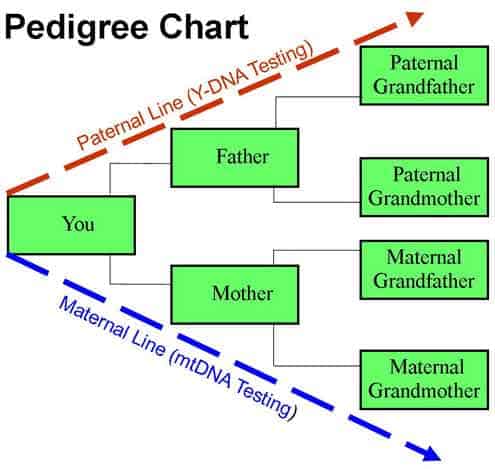
Ray and Nori had their DNA tested last year by 23 and Me, the company used in the PBS series "Faces of America". We had some questions about the make up of Nori's paternal ancestry. Since Nori didn't have any brothers, we couldn't get to the paternal questions unless 23 and Me was used as they test somethings that other companies don't but it's not complete by any means, more of a guess. They also did the health portion which is of use to our family as well as their sibling's families
So today, we will discuss MATERNAL DNA. In order to understands what this all means, we need to have a little science lesson, otherwise it won't be clear what we have learned and from what family is concerned. I will cover this in several blog posts as it is long (and maybe a little boring). This is from the 23 and Me website:


So to lay this out:
So today, we will discuss MATERNAL DNA. In order to understands what this all means, we need to have a little science lesson, otherwise it won't be clear what we have learned and from what family is concerned. I will cover this in several blog posts as it is long (and maybe a little boring). This is from the 23 and Me website:
What is mitochondrial DNA (mtDNA)?
Small structures called mitochondria reside in every cell in your body. Within each of these structures is a tiny circular genome. We call the DNA of this genome "mitochondrial DNA" or "mtDNA" for short.
Unlike the rest of your genome, mtDNA is only passed on from mother to child; mtDNA inheritance is "maternal," tracking your ancestry through your mother, your mother's mother, your mother's mother's mother, and so on.
So to lay this out:
Ray Riley to Selma Brueggeman to Emma Louise Long to Louise Nagel
Using Mitochondrial DNA we are getting the Ancestral Information on Selma's mother and her mother but not her father (Ernst August) and his father (Clamor). We would need one of Ernst August's grandsons of one of his son's to get to this info. Or to get to Clamor, one of his son's son's. In other words, if your last name is still Brueggeman (or Brugge), you would be able to find out about Clamor's Ancestral DNA.
Think this enough for today but I will tease you --- there was a little surprise on Ray's maternal DNA so stay tuned.
Subscribe to:
Posts (Atom)